|
||||
| Home | Introduction | Szasz Materials | Debates | Links/Related Items |
|
|
||||
Society for Humanistic Psychology
"Szasz Hates Laing"
In a recent issue of Existential Analysis, "Debunking Antipsychiatry: Laing, Law, and Largactil," Thomas Szasz (2008) has nothing to express but acrimony toward R.D. Laing.
Most of Szasz's bitterness toward Laing appears to stem from David Cooper's (1967) use of the term "anti-psychiatry"
the book Psychiatry and Anti-Psychiatry. The term "anti-psychiatry" became a label to describe the cohort in which Laing was the figure-head, including Cooper, Joseph Berke, Leon Redler, and others. Even though Laing rejected the term "anti-psychiatry," Szasz argues that Laing's rejection was inauthentic. Szasz strongly resents the term "anti-psychiatry" because it tends to be a label that is now applied to him, in addition to Laing, Foucault and other voices who Szasz--to put it mildly--would prefer not be associated with. In practice, the prejorative tone of the term "anti-psychiatry" has often become a way to stigmatize and ridicule any critical voice in the medical field who raises legitimate questions about some of the founding assumptions of psychiatric diagnosis and treatment.
While Szasz rejects the term "anti-psychiatry," he clearly and without any ambiguity has persistently argued over the years that mental illness does not exist -- that psychiatric diagnostic categories are, in essence, fictional entitites -- and that medical treatment of mental illness is a form of coercion and control. These are sentiments that many also attribute to Laing in addition to the French social critic Michel Foucault, for example. Szasz however insists that he differs from Laing and continental thinkers such as Foucault because he sees them as pushing a Leftist political agenda that he rejects, from within a more Libertarian perspective, as just another assault on personal liberty.
But more interesting, Szasz's article in Existential Analysis can be read as nothing other than a full-frontal assault on R.D. Laing's character and, by implication, his credibility as a clinician and scholar. He paints him to be an irresponsible, reckless and power-hungry monster. For example, Szasz writes that Laing:
"...had no touble abandonding women and children and breaking his promises to patients. We can 'detach' ourselves from certain unwanted experiences, for example threatening erotic feelings, but we cannot, properly speaking, 'detach' ourselves from our responsibilities. When we do so, we are irresponsible, not detached. In my view, Laing was pervasively irresponsible, systematically refusing to accept responsibility for his actions
their consequences" (p. 320).
Szasz reserves his harshest criticisms for Laing' role in serving as an expert witness in the case of John Thomson Stonehouse, who after faking his own death was charged with fraud and plead not guilty by reason of insanity. Laing testified under oath that Stonehouse was insane at the time of the crime. Szasz responds by saying, "Laing and Stonehouse were both liars, plain and simple" (p. 323).
Szasz is also highly critical of what he perceives to have been Laing's hypocrisy regarding non-coercive approaches to treatment. He was critical of medical interventions in some places, Szasz argues, but then advocated the use of LSD for the treatment of mental illness and used Thorazine on one of his patients in Kingsley Hall, according to Szasz account, which is apparently documented by both the victim (Sigal) and a surviving witness (Berke). As a result, Szasz says that Laing was little more than a "successful psychiatric con-man" (p. 332)
Do Szasz's charges amount to little more than a personal rant? Or does Laing's character make a difference when it comes to the serious assessment of the value of his work for the field? Personally, I think Szasz lowers himself by performing character assassination on a man who is deceased and therefore unable to defend himself -- as much as what he says about Laing may indeed be true and well-documented. Laing may have been a son-of-a-bitch at least some of the time, but what business does this gossip have in a peer-reviewed journal? Are we not, as professionals, above fallacious, ad hominem styles of argumentation? Even a broken clock is right twice a day, and few without prejudice would deny that Laing's work has a timeless quality that will demand serious consideration for some time to come. With that said, I agree David Cooper made a grave err in judgment with the introduction of the term "anti-psychiatry" into the lexicon -- a term that today amounts to the label of "Scientologist" for any one who dares question the ruling elite of psychiatric medicine.
References
Szasz, T. (2008). Debunking antipsychiatry: Laing, law, and largactil. Existential Analysis, 19(2), 316-343.
Posted by Brent Robbins, PhD at 7:33 AM
4 comments:
Szasz's critique of psychiatry has always focussed on its two paradigmatic activities: (a) coercing the innocent; (b) excusing the guilty. Szasz insists that both these activities are illegitimate. His critique of Laing focusses on two well-substantiated events, in which Laing practised (a) and (b) respectively. He points to these events as evidence that Laing did not renounce these two paradigmatic activities of psychiatry. He also points out that Laing did not repudiate these activities even in theory. To dismiss Szasz's searching critique of Laing's professional practice and theory as ad hominem "gossip" is absurd.
February 7, 2009 3:57 PM
Jeffrey said...
Robbins’s ad hominem comment (“Szasz Hates Laing”) suggests that he is unfamiliar with Szasz’s vast corpus and, specifically, with his critique of antipsychiatry in “Schizophrenia: The Sacred Symbol of Psychiatry” (1976).
Szasz writes:
“Psychiatry and antipsychiatry resemble one another, not only as opposites usually do, but also in their shared obsession with ‘schizophrenia’ and its management.” After describing the symmetrical psychiatric-antipsychiatric models of schizophrenia, Szasz – in an often quoted passage – continues: “What both of these models obscure are the simplest and most ancient of human truths: namely, that life is an arduous and tragic struggle; that what we call 'sanity' – what we mean by 'not being schizophrenic' – has a great deal to do with competence, earned by struggling for excellence; with compassion, hard won by confronting conflict; and with modesty and patience, acquired through silence and suffering" (pp. 82-83).
Robbins acknowledges, “Much as what he [Szasz] says about Laing may indeed be true and well-documented. Laing may have been a son-of-a-bitch at least some of the time, but what business does this gossip have in a peer-reviewed journal?”
Nevertheless, Robbins dismisses Szasz’s important documentation as “gossip,” “rant,” and “character assassination.” And he laments its publication.
Actions speak louder than words. That R. D. Laing – the leading representative of the antipsychiatry movement – was a shameless practitioner of psychiatric coercions and excuses is fact, not gossip. Robbins’s attempt to obstruct the recognition of this fact supports Szasz’s contention that psychiatry and antipsychiatry are cognate competing cults.
Jeffrey A. Schaler
schaler@american.edu
February 8, 2009 12:43 PM
edmendelowitz said...
As for Szasz, my thoughts--like his own---have not really changed in quite some time. He is, essentially, a one-trick pony who has been saying exactly the same things now for many years. An important and partial truth. Laing, of course, was severely alcoholic and, oftentimes, wildly inappropriate. The quality of his writing, thought, and, indeed, demeanor vacillated wildly. Still, there is a brilliance in the best of his work that Szasz (and we, too, for that matter) simply cannot touch. If Laing was guilty of romanticizing schizophrenia, Szasz similarly turns mountains into molehills by eradicating the phenomenon (or, rather, a grouping of phenomena) outright. The first half of Laing's Voice of Experience (a final great work) expresses Szasz's essential agenda with a perspicacity and depth and feeling for the humanities of which Szasz, in my experience, is incapable. To dismiss Laing outright is, for the sensitive student of the literature, as philistine as all the hagiography--why profound souls like Robert Coles and Rollo May paid him such thoughtful tribute.
This particular blog posting, while interesting and even quaint, impresses me as reductionist and somewhat passe just as well. Szasz vs. Laing, one overweening ego relentlessly pursuing an oftentimes recklessly brilliant psychoanalyst and writer who is now dead. The real discussion, with the publication of Louis Sass's Madness and Modernism in 1992, takes place on far more rarefied ground. Sass's work is a terribly erudite study of schizophrenia and modernism that leaves the old debate more-or-less in the dust. It is high time that we humanistic psychologists get off the old shibboleths and get on with things ourselves. Nonetheless, it is a thoughtful and articulate piece by Brent (I am glad to see that he is capable of this), and (he is right) the problem with what we may call "corporate occupation" of the human heart and mind remains both prodigious and unabated: consider the political/economic upheaval we currently witness on all sides. Even here, however, there is the plaintive wisdom of Kafka: 'Only in the chorus may be found a certain truth.'- Ed Mendelowitz
February 19, 2009 4:53 AM
Brent Robbins, PhD said...
For those who criticize me for pointing out Szasz's criticisms of Laing as fallacious, ad hominem attacks: You're obviously wrong, because you are so morally depraved, irresponsible and stupid you wouldn't know the truth if it bit you in the arse. Even if you disagree with me, I'll just wait until you're dead and can't defend yourself, then I'll smear your name and character through the mud and declare victory over your worm-eaten corpse. /irony
Seriously, though: Szasz style of argumentation is inflammatory because he claims to discredit Laing's ideas by attacking his character. That's ad hominem. Even if Laing failed to live up to his own ideals, it doesn't invalidate the ideals themselves.
Actions may speak louder than words. But they are irrelevant to the validity of a person's theoretical arguments. To believe that they are relevant, is to fall prey to the ad hominem fallacy. Simple as that.
Alright, Szasz hates Laing. He thinks he's a goddamn liar and a no-good son-of-a-bitch. But so fucking what? It doesn't make Laing wrong.
February 19, 2009 7:48 PM
Division 32 of the American Psychological Association.
Friday, February 6, 2009
Anthony Stadlen said...
"'The myth of mental illness': No phrase has had as profound an impact on public attitudes toward the mentally ill as this provocative title of a
1960 [sic] book by maverick psychiatrist Thomas Szasz . . . Szasz's views were greeted with
enormous enthusiasm in the sixties (p. 607) . . . Involuntary hospitalization should be restricted
to those who threaten harm to others or who are suicidal (P. 608) . . . But Szasz's challenges have
been met. Schizophrenia is an illness because it meets the usual definitions of one. ...
it can be reliably diagnosed using clearly defined criteria. Schizophrenia is no myth.
What is true for schizophrenia is also true for other forms of mental illness (P. 612) . . . How
could Szasz and his disciples have been so wrong about the existence of mental illness?
Many of them were bright people; a fair number, like Szasz himself, even had direct contact with
the mentally ill.... In part, they were the victims of their time...(P. 614) . . . We can no longer
ignore the fact that one of the symptoms of severe mental illness is in many cases a denial that
something is wrong. ... Mentally ill persons cannot always be relied upon to seek help when they
need it."(P. 615.)--Paul S. Appelbaum, "Mental Illness: No Longer a Myth," The World & I (Washington Times), November 1987, pp. 607-615.
"In principle, the duty to protect is difficult to reject, especially for members of a profession
dedicated to assisting others in need. Indeed, I suspect that ... by seeking to guard potential
victims of their patients from harm, clinicians as a group would endorse the trend toward broader
duties to rescue (P. 104) . . . Mental illness by definition calls the soundness of the mind--and
therefore the legal competence--of the actor into question. This perspective ...accounts (in part)
for the traditional assumption that consent for treatment need not be obtained from the mentally
ill (P. 119)
"Now, more than three decades later, Scheff, Szasz, Laing, and their colleagues are no longer fixtures in psychology and sociology courses.
Most college and graduate students have never heard of them or their argument that mental illness
is a socially derived myth. Academic critics have picked their arguments apart, and though Szasz,
for one, is entirely unrepentant, many theorists who denied the existence of mental illness three
decades ago are somewhat embarrassed now about their former beliefs. (p.7) . . . The most extreme
views of this sort--often called 'anti-psychiatry'--would have led to much more sweeping changes
than actually occurred. Civil commitment would have been abolished rather than restructured,
voluntary as well involuntary treatment would have been prohibited . . . " (pp. 213-214).
--P.S. Appelbaum. Almost a Revolution: Mental Health Law and the Limits of Change.
New York: Oxford University Press, 1994.
"The right to refuse antipsychotic medication is now more than a decade old. ...
[R]efusal is not uncommon, but refusing patients appear almost always to receive treatment in the
end. These findings point up the essential illogic of allowing committed persons to refuse treatment
that would permit their freedom to be restored. " (Pp. 413-414)
--Paul S. Appelbaum, "The right to refuse treatment with antipsychotic medications: Retrospect and prospect,"
American Journal of Psychiatry, 145: 413-419 (April), 1988.
Todd Seavey, formerly of ABC's 20/20 with John Stossel, attacks Szasz and Schaler as "Director of Publications" for the American Council on Science and Health" [cf Transcript of Voice of America Broadcast pitting Schaler v. Elizabeth Whelan and Gilbert Ross, May 31, 2001
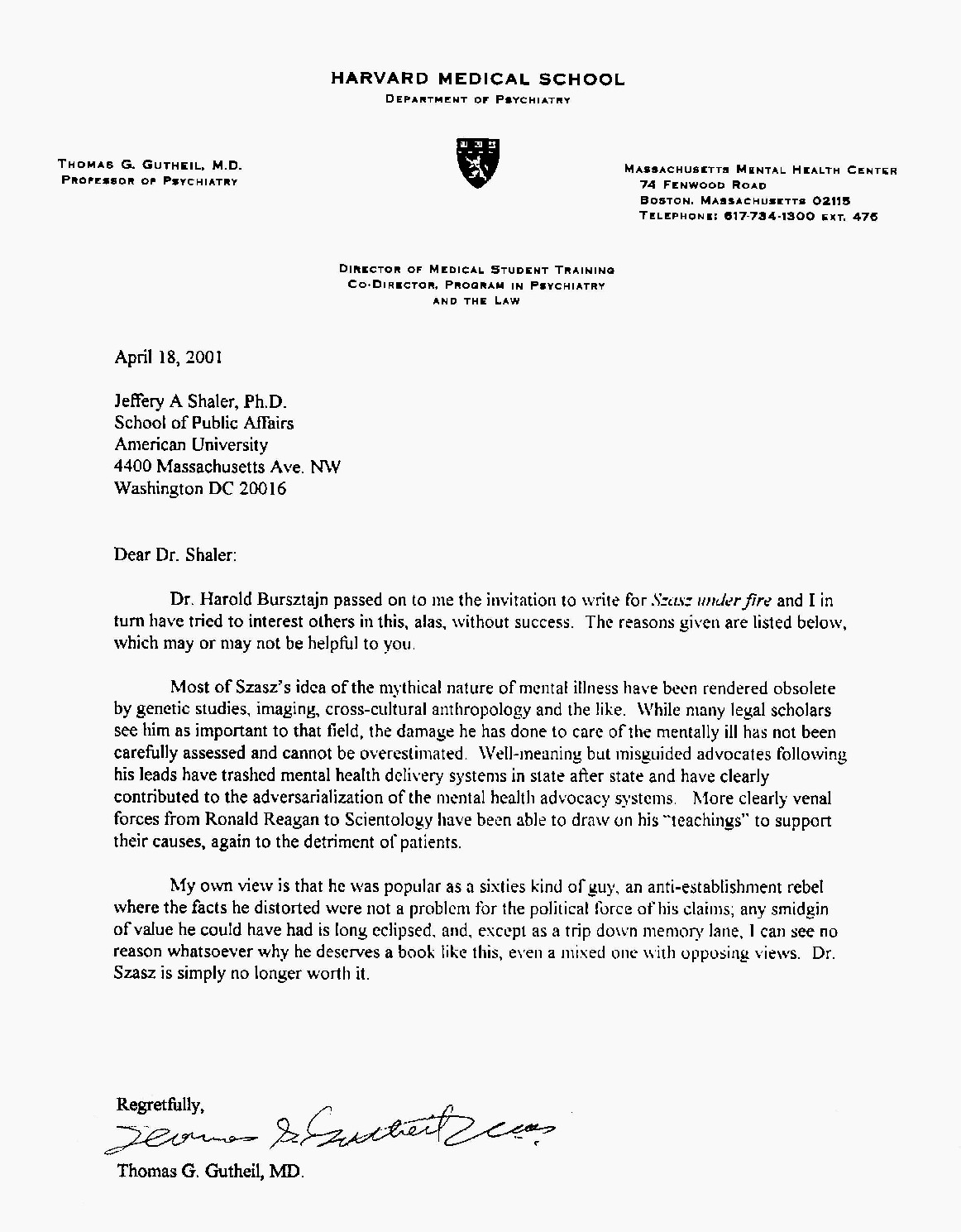
[Note: Click here to view a scanned image of the original letter below. "Szasz under fire" refers to Schaler, J.A. (Ed.)(In press.) Szasz under fire: Thomas Szasz faces his critics. Chicago: Open Court Pub. Publication expected in 2002]
HARVARD MEDICAL SCHOOL
DEPARTMENT OF PSYCHIATRY
MASSACHUSETTS MENTAL HEALTH CENTER
74 FENWOOD ROAD
BOSTON, MASSACHUSETTS 02115
TELEPHONE: 617-734-1300 EXT. 476
THOMAS G. GUTHEIL, M.D.
PROFESSOR OF PSYCHIATRY
DIRECTOR OF MEDICAL STUDENT TRAINING
CO-DIRECTOR, PROGRAM IN PSYCHIATRY AND THE LAW
April 18, 2001
Jeffery A Shaler, Ph.D.
School of Public Affairs
American University
4400 Massachusetts Ave. NW
Washington DC 20016
Dear Dr. Shaler:
Dr. Harold Bursztajn passed on to me the invitation to write for Szasz under fire and I in turn have tried to interest others in this, alas, without success. The reasons given are listed below, which may or may not be helpful to you.
Most of Szasz's ideas of the mythical nature of mental illness have been rendered obsolete by genetic studies, imagin, cross-cultural anthropology and the like. While many legal scholars see him as important to that field, the damage he has done to care of the mentally ill has not been carefully assessed and cannot be overestimated. Well-meaning but misguided advocates following his leads have trashed mental health delivery systems in state after state and have clearly contributed to the adversarialization of the mental health advocacy systems. More clearly venal forces from Ronald Reagan to Scientology have been able to draw on his "teachings" to support their causes, again to the detriment of patients.
My own view is that he was popular as a sixties kind of guy, an anti-establishment rebel where the facts he distored were not a problem for the political force of his claims; any smidgin of value he could have had is long eclipsed, and, except as a trip down memory lane, I can see no reason whatsoever why he deserves a book like this, even a mixed one with opposing views. Dr. Szasz is simply no longer worth it.
I regret that neither I nor Dr Burstajn was able to help, nore were our recruiting attempts successful to get any one else to care enough to do it.
Regretfully,
(signed)
Thomas G. Gutheil, MD.
( FLAWED ARGUMENT )
by Arieh Shalev
23 February 2001, posted 24 April 2001
Frankly, I find the Szasz argument flawed, superficial, demagogic and immoral.
It is flawed because since when is medicine exclusively
concerned with diseases with known bodily etiology? I have
learned that the mission of medicine, within society, is to care for
those who suffer. What have we known about epilepsy 100 years
ago? How much do we know about migraine at the present day?
Should we wait for anatomical proof before we treat a patient with
law back pain? And what if X-Rays do not reveal abnormal
findings - wouldn't we alleviate the pain ?
It is superficial because it assumes a yes/know type of biomedical
knowledge, whereas the truth is that most knowledge is relative -
and new mechanisms are being discovered as new technologies emerge.
Neuro imaging, in fact, has already 'objectified' some of the processes that underlay
mental disorders.
It is demagogic because it emphatically uses concepts out of their
proper context. If it is right that Internists will classify internal
diseases, based on their knowledge of them why is it wrong that
psychiatrists will create a classification of mental disorders. I'll tell
you what is the demagogic essence of the argument here:
'Psychiatrists' are inherently bad and therefore should not be
trusted with classifying their observations. Whatever 'psychiatrists'
see is inherently flawed. Have you heard similar arguments
regarding Jews ? Jewish literature ? Jewish Science ? It is also
demagogic in that it ignores the fact that psychiatrists do not use
the term disease but rather disorder. I personally explain it to each
medical student in my department: we call these conditions 'disorders' because
we don't have a final physiological proof of their underlying mechanisms
Finally it is immoral because along with claiming high humanitarian
standards it offers no relief to humans who suffer (and please,
please don't tell me that schizophrenics do not suffer). Indeed, the
best that has ever been done for schizophrenics was when, based
on presumed bodily dysfunction, people started to look for
medication that alleviate their symptoms - and have quite nicely
succeeded. I feel amazed, embarrassed and ashamed that
passages such as the one that I been sent yesterday (Szasz, 2000)
can still seduce intelligent minds.
One thing is to discuss the right of mental patients for freedom and
self regulation. Another thing is to deny their need for help
and the veracity of their disorder.--Arieh Y. Shalev, M.D., Professor of Psychiatry, Head, Department of Psychiatry, Hadassah University Hospital, Jerusalem, 91120, Israel, Phone (972) 2 6777184, Fax (972) 2 6412642, e-mail ashalev@cc.huji.ac.il
"Another group of critics of addiction are libertarians, who believe that all behavior is intentional
and that alcoholism is unfounded at its roots since people choose each drink and exposure to drugs.
In other words, there are no grounds on which to separate intensive drug use - or compulsive behavior
of any sort - from ordinary intentional behavior (see Schaler, 1999). Peter Cohen (this issue) represents
a point of view that has elements of nominalism and libertarianism called constructivism. This view,
focusing on data showing that use of powerful drugs like cocaine is so relative, so subject to change,
so often controllable or able to be brought under control, agrees with libertarians that addiction is
nonexistent, a fabled concept with no real referent.
However, these critics must run for cover when confronted with individuals like David Kennedy
(deceased son of Robert Kennedy), Jason McCallum (deceased son of the actors David McCallum and Jill
Ireland), or Robert Downey, Jr., who report being addicted and who do not cease their drug use under
the most dire threats or actual endangerment of their lives up to and including death. What should we
call it when someone like Jim Morrison, of the Doors, repeatedly pours alcohol nonstop down his throat
for hours and dies of a heart attack in his twenties? And there are noncelebrity examples of similar
behavior. To confront a radical critic who claims addiction does not exist with such a self-destructive
individual is to reveal the critic as an academic completely unprepared to deal with addicts.
It is unwise and unnecessary to deny the reality of people's experience - experience that can have crucial,
even life and death, effects. People experience compulsions and enact them, leading to serious injury to
themselves and others. This is not to excuse such behavior criminally or to accept that it is biologically
foreordained. But a notion of addiction is required to respond to critical realities of drug use. Such an
addiction concept also serves as a template - as one extreme of a continuum which, while rarely fully realized,
sets up a typology the opposite end of which is controlled use. It is also helpful to have this concept in one's
repertoire when required to deal with extreme cases of substance abusers - resisting the danger, again, of
reifying this into the idea that such a person's behavior is immutable (which may actually exacerbate the
problem behavior - Kennedy, McCallum, and Downey had collectively been through chemical dependence treatment many times)."
--Stanton Peele, What Addiction Is and Is Not: The Impact of Mistaken Notions of Addiction.
Addiction Research, 8:599-607, 2000
"In his May 21 letter commenting on the article ''My Brother Might Kill Me''
(Op-Ed, May 6), Dr. Thomas Szasz writes that the behavior of Jane Doe's brother
''epitomizes the human propensity to injure and kill - in a word, violence.''
Such a statement perpetuates the myth of ''the death instinct,'' long
associated with psychoanalysis - which has been irreverently described as the
study of the id by the odd - and is a belief of quite ancient vintage. When I
was a boy it went by the name of ''innate depravity,'' which placed one
particularly at risk on those interminable Sundays so oppressively full of
intangible restraints, which somehow made it sinful to listen to secular music
or take a walk in the park.
However, as a scientist who has made a lifelong study of the nature of human
nature, and especially of the alleged innate aggressiveness of humankind, I
find, as many of my colleagues have, that there exists no evidence whatever to
support the notion of a ''human propensity to injure and kill.''
It is easy enough to attribute such aggressive behavior to ''propensities,''
and, of course, it explains everything. But the truth is that it is a false view
of the origins of human violence, and very damaging, leading to such absurdities
as Professor Szasz's recommendation that what criminals need is punishment.
That precisely is what criminals do not need. What they need is understanding
- understanding of the conditions that caused them to become criminals together
with the correction of those conditions so that there may be no more criminals.
Building more jails for punishment is less than helpful; it is to ignore the
problem.
What is needed is the building of a society that satisfies the basic behavior
and physical needs of every child for growth development and fulfillment,
epitomized in the need for love. But how many of us really understand the
meaning of that word and its significance for the survival, no less, of our
species? It is in the failure to answer that question that our problem lies."
--ASHLEY MONTAGU, Princeton, N.J., May 22, 1987, "There Is No Innate Human Propensity to Kill," Letters to the Editor, The New York Times, p. 28, June 7, 1987.
Cathy Young, Contributing Editor, REASON Magazine, on Thomas Szasz and the myth of mental illness.
"On Myths and Countermyths" [PDF file] by Ronald Pies, M.D., excerpt from Archives of General Psychiatry,33:139-144, 1979.
"Unlike Szasz . . . I believe psychiatric disorders distort thought,
mood, and judgment, limiting informed choice and leading to outcomes that
would not occur in the absence of a potentially treatable illness.
Psychiatric disorders, not physicians or families, restrict informed choice
in these instances."--Andrew E. Slaby, M.D., Ph.D., clinical professor of psychiatry at the New York University and New York Medical College and past president of the American Association of Suicidology in a review of Fatal Freedom: The Ethics and Politics of Suicide by Thomas Szasz, Psychiatric Services, Volume 52, No. 1, pp. 114-115, January 2001.
"Since mental illness negates our assumption of rationality, we do not
hold the mentally ill responsible. It is not so much that we excuse them from
a prima facie case of responsibility; rather, by being unable to regard them
as fully rational beings, we cannot affirm the essential condition to viewing
them as moral agents to begin with. In this the mentally ill join (to a
decreasing degree) infants, wild beasts, plants, and stones--none of which
are responsible because of the absence of any assumption of rationality."
--Michael S. Moore, "Some myths about mental illness," Archives of General
Psychiatry, 32: 1483-1497 (December), 1975; p. 1495.
Thomas S. Szasz Cybercenter for Liberty and Responsibility:
Copyright © 1998-2000 by the author of each page, except where noted. All rights reserved.